How Robotics and AI Are Supercharging Reverse Vending Machines in 2026
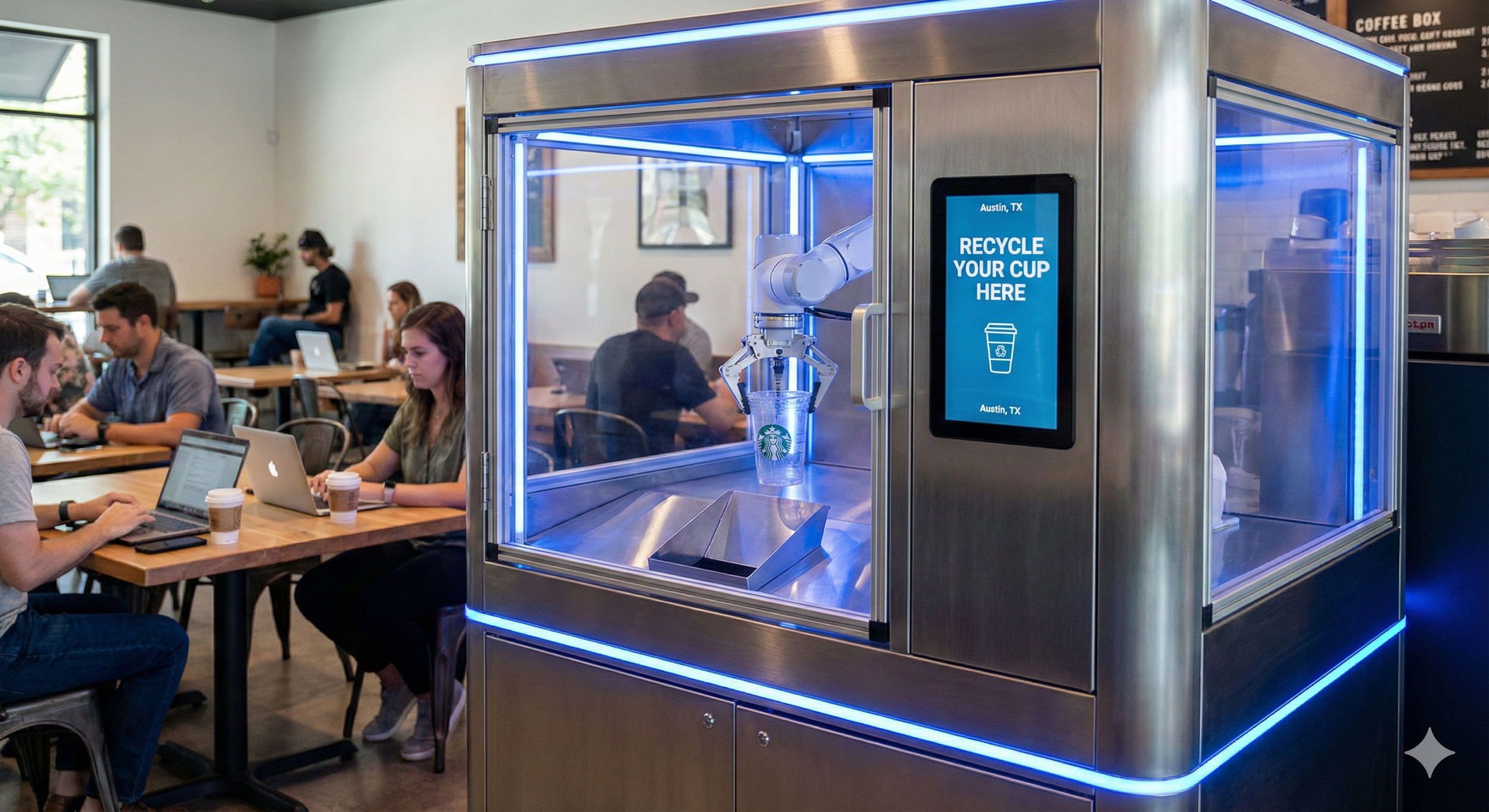
Reverse vending machines (RVMs) have evolved from simple deposit-return kiosks into intelligent systems powered by robotics and AI, achieving material recognition accuracies above 99% and processing speeds of 60+ items per minute. This transformation is critical for scaling recycling in urban environments, where beverage container waste—particularly polypropylene (PP) from coffee cups—contributes significantly to landfill volumes. As of 2025, global RVM deployments exceed 82,000 units, driven by deposit return systems (DRS) in over 50 markets.
Educational takeaway: For startups in recycling tech, understanding these integrations starts with core technologies like multi-spectral sensors and neural networks. TOMRA's Flow Technology™, for instance, uses 360° instant barcode and security mark detection to eliminate rotation delays, enabling continuous flow processing of PET, aluminum, and glass containers
In a 2025 pilot by Tom Robots in Italy, AI-driven Plastic RVMs combined near-infrared (NIR) spectroscopy with robotic grippers to sort contaminated plastics, reducing downstream processing costs by 25% through cleaner feedstock.
Real-world example: AMP Robotics' systems, deployed in Bay Area facilities since 2024, leverage edge AI for real-time anomaly detection in mixed waste streams, identifying and ejecting non-recyclables like lids or residues before compaction. This has boosted recovery rates for PET and PP by 30% in partnered MRFs, per Closed Loop Partners' financing reports.
Similarly, in Thailand's 2023 hypermarket chain study across 15 sites, RVMs with IoT-enabled robotics collected 21% more PET bottles than manual systems, yielding high-purity flakes suitable for closed-loop reuse.
For Austin-based innovators, these advancements align with local opportunities under the city's 2025 Zero Waste Plan, which targets 90% diversion by 2040 and now includes coated paper cups in curbside programs.
Startups can prototype similar setups using open-source IoT frameworks like MQTT for remote monitoring, ensuring scalability from coffee shop pilots to city-wide networks.
Key lessons for commercialization:
Sensor Fusion for Accuracy: Combine NIR, RGB, and weight sensors to handle deformed or stained items, as in TOMRA's Essential Technology for emerging DRS markets.<grok:render card_id="25e991" card_type="citation_card" type="render_inline_citation">
9
Robotic Handling: 6-axis cobots prevent crushing thin PP cups, enabling gentle sorting at rates matching peak-hour café traffic.
AI Model Training: Datasets from >2 million labeled images (e.g., AMP's approach) allow over-the-air updates, improving weekly by 5-10% in contamination rejection.
By 2026, expect hybrid RVMs integrating 5G for fleet-wide data sharing, per EU targets for 55% plastic recycling by 2030.
For Texas startups eyeing EPR credits or resale of clean flake ($800–$1,200/ton), these technologies offer a blueprint for investor-ready pilots.
Curious how to adapt these for your recycling startup? Austin Mechatronics offers educational consultations on robotics prototyping—reach out to explore R&D pathways.
Further Reading
TOMRA's AI in Reverse Vending (nofollow)
AMP Robotics' Edge AI for Sorting (nofollow)
Thailand RVM Study on Collection Rates (nofollow)
Bay Area Olyns AI-Powered RVMs (nofollow)
EU Plastic Recycling Targets (nofollow)